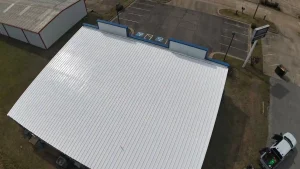
Two Categories of Commercial Roofing: Why the Difference Matters
Before we get into maintenance, it is important to understand that commercial roofing is not one thing. In Central Arkansas, most commercial buildings fall into one of two categories:
Low slope roofing: flat or nearly flat roofs, typically found on warehouses, retail buildings, office complexes, churches with large sanctuary roofs, and strip centers. These systems are designed to shed water slowly through drains, scuppers, and tapered insulation rather than steep pitch.
Steep slope roofing: pitched roof systems on commercial buildings, typically found on churches, restaurants, historic buildings, multi family properties, and some retail spaces. These use the same general principles as residential roofing but at a larger scale and often with more complex geometry.
They have different materials. Different failure points. Different maintenance requirements. And they require a roofer who understands both, not just one.
Low Slope Commercial Roofing: What We See in Saline County
Low slope roofing is by far the most common commercial roof type across Central Arkansas. If you drive through the commercial corridors of Benton, Bryant, or Malvern, the majority of what you are looking at is low slope: TPO membranes, EPDM rubber, modified bitumen, built up roofing (BUR), and flat seam metal systems.
These systems are engineered to perform for 15 to 30 years with proper care. Without it, that number drops dramatically.
Here is what we find most often during commercial low slope maintenance inspections:
Membrane Seam and Lap Failures
The seams where membrane panels overlap are the most vulnerable points on any low slope roof. On TPO and EPDM systems, heat welded or adhesive seams are subject to UV degradation, thermal movement, and foot traffic stress over time.
When a seam fails, it does not announce itself. Water enters quietly, migrates under the membrane, saturates the insulation, and begins working on the roof deck, often for months before any interior sign appears.
What maintenance does: Seams are inspected and probed at every maintenance visit. Early separation is resealed before water ever enters the system.
Ponding Water and Drain Issues
Low slope roofs depend entirely on their drainage systems to function. Drains, scuppers, and overflow outlets that become clogged with debris, leaves, or sediment allow water to pond on the roof surface.
Ponding water (standing water that remains 48 hours or more after a rain event) is one of the leading causes of premature membrane failure on commercial roofs in Central Arkansas. It adds structural load, accelerates UV breakdown, and creates ideal conditions for biological growth that further degrades the membrane surface.
In a climate with Saline County’s rainfall levels and leaf debris from mature tree canopy, drain maintenance alone is worth the cost of a plan.
What maintenance does: Every drain, scupper, and overflow outlet is cleared and checked for proper flow at each visit. Ponding areas are identified and documented so the underlying drainage issue can be addressed before it causes membrane failure.
Flashing Failures at Penetrations and Parapets
Commercial low slope roofs have significantly more penetrations than residential roofs: HVAC curbs, exhaust fans, pipe stacks, gas lines, electrical conduit, and more. Every one of those penetrations is a potential leak point. Add to that the perimeter parapet walls and edge metal details, and a commercial roof can have dozens of individual flashing points that require regular inspection.
Flashing on a low slope roof is subject to the same thermal movement as the membrane, expanding in Arkansas summer heat and contracting in winter, which gradually works at sealants and adhesives until they fail.
What maintenance does: Every penetration, curb, parapet, and edge detail is inspected and resealed as needed. This is where a significant percentage of commercial roof leaks originate, and it is where maintenance pays for itself most visibly.
HVAC Unit and Equipment Curb Wear
Most commercial buildings in Saline County and across Central Arkansas have rooftop HVAC equipment, and those units are a chronic source of roof problems. Vibration from the equipment loosens fasteners and works at curb flashings. Condensate drains overflow or become clogged, directing water across the membrane surface. Service technicians walking to and from units create wear paths that degrade the membrane over time.
What maintenance does: HVAC curb flashings are inspected and resealed. Walk paths are evaluated for wear. Condensate drainage is checked for proper function. This keeps your roofing system and your mechanical systems from working against each other.
Modified Bitumen and BUR Specific Issues
Older built up roofing systems and modified bitumen roofs, both common across Central Arkansas’s existing commercial building stock, have their own specific failure patterns. Alligatoring of the surface ply, blistering from trapped moisture in the insulation, and fish mouthing at laps are all common indicators of a system under stress.
These systems are often repairable and can have their lives extended significantly with proper maintenance, but only if problems are caught before they compound.
What maintenance does: Surface condition, blister activity, and lap integrity are documented at every visit. Minor repairs are made while they are still minor. When a system is approaching end of life, the building owner has documented data and enough lead time to plan a replacement strategically rather than reactively.
Steep Slope Commercial Roofing: Churches, Restaurants, and Mixed Use Buildings
Not every commercial building in Central Arkansas has a flat roof. Churches, restaurants, older retail buildings, and many mixed use properties across Benton, Malvern, and Hot Springs Village have steep slope systems, and they present a different set of maintenance challenges.
The core difference from residential steep slope is scale, complexity, and consequence. A commercial steep slope roof may cover 40, 60, or 80 plus squares with multiple ridgelines, dormers, valleys, and penetrations. Getting on it safely requires proper equipment. Maintaining it properly requires experience with commercial scale systems.
Here is what we commonly find on commercial steep slope roofs during maintenance visits:
Large Scale Shingle and Metal Panel Wear
Commercial steep slope roofs age the same way residential ones do, but the surface area and geometry involved means that problems develop in more places simultaneously and are easier to miss. Nail pops, lifted flashings, and granule loss across a 60 square commercial shingle roof can represent a significant and growing vulnerability that a cursory ground inspection will not catch.
On steep slope metal systems, common on churches and agricultural adjacent commercial buildings across Saline County, fastener backing, panel seam separation, and ridge cap sealant failure are the primary maintenance concerns, just at a larger scale than residential metal.
What maintenance does: A trained technician covers the full roof surface methodically, identifying and addressing wear points that a ground inspection or occasional glance from a bucket truck would miss entirely.
Valley and Flashing Complexity
Commercial steep slope roofs frequently have far more complex geometry than residential roofs: multiple intersecting roof planes, long valley runs, dormers, steeples, and architectural features that create multiple points where water is concentrated and directed. Every valley intersection and every flashing transition is a potential failure point.
On a church with a 70 year old roof line that has been patched and re patched over the decades, those transition points can be a complicated mix of materials and ages that require an experienced eye to evaluate properly.
What maintenance does: Valley systems, step flashings, counterflashings, and architectural transition points are inspected and documented. Failing components are identified and addressed before water finds them first.
Gutter Systems at Commercial Scale
Commercial steep slope buildings typically have large volume gutter and downspout systems that handle significant water flow during Central Arkansas rain events. Clogged or failing gutters on a commercial building do not just overflow, they can direct water against the fascia, into the soffit, and back up under the first course of shingles or panels, creating a chronic moisture problem at the eave.
What maintenance does: Gutters and downspouts are cleared, checked for proper pitch and secure attachment, and inspected for wear at every maintenance visit. Downspout discharge is verified to be directing water away from the foundation.
Low Slope vs. Steep Slope: How Maintenance Plans Compare
| Feature | Low Slope Commercial | Steep Slope Commercial |
| Common systems | TPO, EPDM, Mod. Bit., BUR, flat metal | Shingle, standing seam metal, tile |
| Primary failure points | Seams, drains, penetration flashings, HVAC curbs | Nail pops, valley flashings, fasteners, sealant |
| Storm damage profile | Membrane puncture, seam stress, drain overload | Wind lifted shingles or panels, hail granule loss |
| Biggest hidden risk | Ponding water saturating insulation | Valley and flashing failures directing water inward |
| Safety requirements | Low: generally walkable | High: proper fall protection required on pitches over 4/12 |
| Inspection frequency | 2x per year minimum plus post storm | 2x per year plus post storm |
| Warranty compliance | Most manufacturer warranties require documented inspections | Varies by system |
Why Commercial Roof Maintenance Is a Business Decision, Not Just a Building Decision
Residential homeowners think about maintenance in terms of their home. Commercial building owners need to think about it in terms of their business or their tenants’ businesses.
The numbers make this case better than anything else. The country’s largest roofing manufacturer conducted a study comparing the total cost of ownership over 24 years for a commercial roof managed reactively versus one managed with a professional preventative maintenance program:
| Cost Factor | Reactive Maintenance | Preventative Maintenance |
| Roof installation cost | $265,000 | $265,000 |
| Maintenance program cost | No Program | $85,000 |
| Leak service | $48,000 | $10,000 |
| Repair cost | $15,000 | $15,000 |
| Life of roof (years) | 12 | 24 |
| Re roof at year 12 | $265,000 | No Replacement Needed |
| Second cycle leak/repair | $63,000 | $0 |
| Total cost over 24 years | $656,000 | $375,000 |
| Annual cost of ownership | $27,333 per year | $15,625 per year |
The preventative maintenance plan delivers 43% savings on total cost per year, not because the roof was cheaper to install, but because it lasted twice as long and required a fraction of the emergency repair expense.
That same manufacturer study found that the average cost to maintain a roof under a professional program runs approximately $0.04 per square foot, while reactive repairs average $0.16 per square foot, four times higher. And that figure does not include what the NRCA calls the hidden costs of reactive maintenance, which compound the real financial impact:
-
Insulation damage: wet insulation loses R value and must be replaced, adding significant cost beyond the membrane repair itself
-
Deck degradation: structural concerns that develop when moisture reaches the roof deck can become a code and safety issue
-
Ceiling tile and interior finishes: damage to tenant or owner occupied space that must be remediated
-
Business disruptions: operational downtime during emergency repairs or water intrusion events
-
Product and inventory loss: particularly relevant for warehouse, retail, and restaurant properties
-
Slip and fall litigation: water on interior floors from an active leak creates direct liability exposure
A roof failure on a commercial property does not just mean a repair bill. It can also mean:
-
Interrupted operations: a leak into a retail space, restaurant kitchen, or office means lost revenue and potentially displaced tenants
-
Insurance complications: most commercial property insurance policies require documented evidence of reasonable maintenance. A building with no inspection history is a building that may face coverage disputes when a claim is filed
-
Property value impact: a well documented, professionally maintained roof is a selling point. An unknown condition roof is a negotiating liability
The most financially sound approach to commercial roofing is not reactive repair. It is a documented, professional maintenance program that gives you control over your building’s largest exposure.
What Commercial Warranty Compliance Actually Requires
This is one of the most overlooked aspects of commercial roofing in Central Arkansas, and one of the most costly mistakes building owners make.
Most manufacturer warranties on commercial roofing systems (TPO, EPDM, modified bitumen, and others) have documented inspection and maintenance requirements built into the warranty terms. Specifically:
-
Annual or semi annual inspections by a qualified contractor are typically required
-
Minor repairs must be addressed within a specified timeframe
-
Documentation of inspections and repairs must be maintained
A building owner who has never had a professional inspection, never documented repairs, and then files a warranty claim after a roofing failure may find that claim denied, not because the product failed, but because the maintenance obligations were not met.
A professional maintenance plan with documented inspection reports and photo records protects your warranty, protects your insurance standing, and protects your claim if something does go wrong.
What a Commercial Maintenance Plan Costs in Saline County
Commercial maintenance plan pricing varies based on roof size, system type, number of penetrations, and complexity. Most commercial properties in Saline County and across Central Arkansas fall into ranges similar to these:
| Building Type | Roof Size | Estimated Annual Plan Cost |
| Small retail or office (low slope) | 20 to 40 SQ | $500 to $900 per year |
| Mid size commercial (low slope) | 40 to 80 SQ | $900 to $1,800 per year |
| Large commercial or warehouse (low slope) | 80 plus SQ | Custom quote |
| Church or restaurant (steep slope) | 30 to 60 SQ | $800 to $1,500 per year |
| Complex steep slope (multi plane, high pitch) | Varies | Custom quote |
Add on services: HVAC curb inspection, drain cleaning, seam sealing, gutter maintenance: are priced separately and can be bundled into a plan based on your building’s specific needs.
For context: a single commercial roof leak that reaches a tenant space, damages equipment, or triggers a liability claim will typically cost far more than several years of maintenance plan fees. The math on preventative maintenance is straightforward; the question is whether you want to make that investment before or after the problem.
How to Know If Your Commercial Roof Needs a Maintenance Plan Right Now
If you are a commercial building owner or property manager in Saline County or Central Arkansas and you are not sure where to start, here is a simple self assessment.
You should call us today if:
-
You have never had a professional inspection of your commercial roof
-
Your building is more than 5 years old and has no documented inspection history
-
You have noticed any staining on interior ceilings or walls
-
You had significant storm activity and have not had a post storm inspection
-
You have a manufacturer warranty and are not sure if your maintenance obligations are being met
-
You are purchasing or selling a commercial property and need a documented condition assessment
Ready to Protect Your Commercial Property?
ARStorm Restoration & Roofing works with commercial building owners and property managers across Saline County and Central Arkansas on maintenance plans tailored to their specific roof systems, whether that is a TPO membrane on a retail strip center in Bryant or a steep slope shingle roof on a historic church in Benton.
We inspect, document, repair, and report, giving you a clear picture of your roof’s condition and a professional record that protects your warranty, your insurance, and your investment.
📍 Serving Benton, Bryant, Malvern, Hot Springs Village, Sherwood, and all of Central Arkansas
Contact us today to schedule a commercial roof assessment and find out what a maintenance plan looks like for your specific building.